
Family business succession planning remains one of the most critical yet frequently postponed challenges for UAE enterprises. The first generation of family business founders is reaching retirement age, creating an urgent need for structured succession planning to preserve business continuity and family wealth.
Commonly cited industry research suggests that approximately 70% of family businesses fail to successfully transition from first to second generation, with only around 10% surviving to the third generation. Bloomberg has reported that nearly $1 trillion in family-owned assets are expected to pass from the first to second and third generations in the UAE by 2030, underscoring the scale of the wealth transfer challenge ahead.
Family businesses represent a substantial portion of the UAE economy. According to Dubai Chambers, they account for up to 90% of private companies in the UAE, employ more than 70% of the private sector workforce, and contribute around 40% to the nation's GDP. The UAE government has recognized this importance through Federal Decree-Law No. 37 of 2022 on Family Businesses, which provides a comprehensive legal framework for family business governance and succession planning. The Dubai Centre for Family Businesses, established in 2023, offers specialized support and training programs for family enterprises navigating succession transitions.
Research published in Qualitative Research in Financial Markets found that succession planning remains one of the biggest challenges for family businesses in the UAE. In the UAE context, succession carries additional complexity. Emirati families must navigate Sharia inheritance principles that mandate specific wealth distribution. Expatriate families face questions about holding structures and succession planning across multiple jurisdictions.
This guide examines practical succession models, governance structures, legal entities including DIFC and ADGM foundations, Sharia inheritance implications, and strategies for preserving business unity during generational transfer.
When to Start Succession Planning
Effective succession planning typically takes many years of preparation. Most advisors recommend beginning the process at least a decade before intended transition. Planning typically begins when the founder reaches 55-60 years old, next generation completes education, or external opportunities arise requiring clarity on ownership.
The cost of delaying manifests when unexpected events force emergency transitions. Founder illness or death without preparation creates immediate crisis with family members unprepared for leadership, no governance structure, and stakeholders uncertain about business continuity.
Common Succession Models
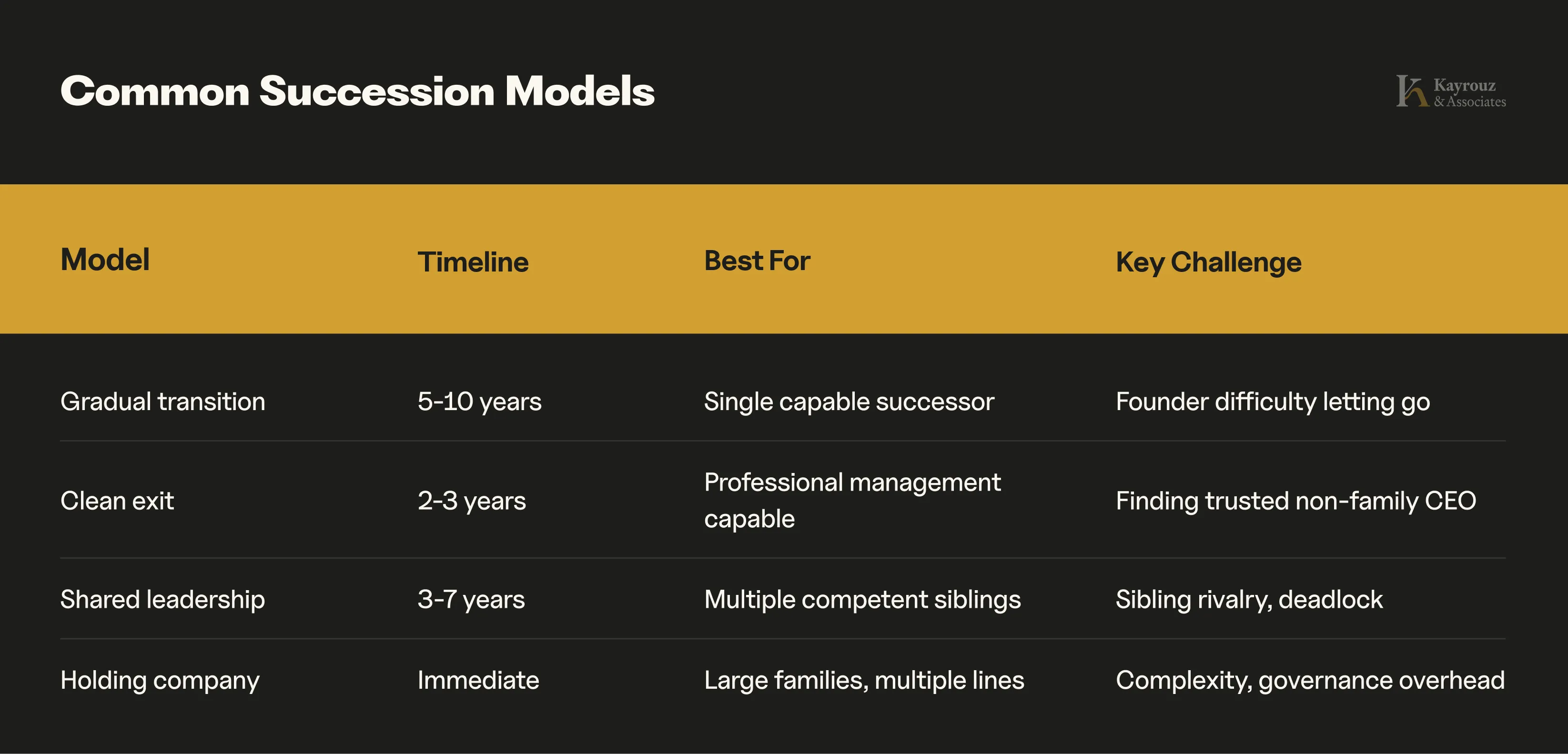
Gradual transition is most common. The founder moves from CEO to Chairman while next generation assumes CEO responsibilities. This allows knowledge transfer but often fails when founders cannot relinquish decision-making authority.
Clean exit involves the founder stepping back entirely while retaining ownership. Professional non-family management runs operations.
Shared leadership among siblings can succeed when responsibilities are clearly divided, but requires exceptional relationships and clear protocols.
Holding company models separate ownership from operations, accommodating large families with varying involvement.
Ownership vs Management
The most important principle is separating ownership from management. Not every shareholder should manage the business, and not every capable manager deserves equal ownership.
Ownership means holding shares, receiving dividends, and voting on major decisions. Management means making operational decisions and executing strategy. Management requires competence and commitment that not all family members possess.
Family businesses succeed when active members manage operations and receive management compensation while passive members hold shares and receive dividends. This separation requires addressing liquidity for passive shareholders through defined dividend policies, buyout options at fair value, or external financing.
Governance Structures
Effective governance allocates decision-making across three distinct bodies:
The Family Council comprises all adult family members and meets quarterly to address family values, business mission, family member entry criteria, dividend policy, and conflict resolution.
The Board of Directors includes family representatives (2-4 members) and independent directors (2-3 experienced business leaders). The board approves budgets, monitors performance, appoints the CEO, and approves major expenditures. Independent directors bring objectivity and mediate family disagreements.
The Management Team runs daily operations, implementing board-approved strategy and reporting to the board rather than individual shareholders.
Reserved matters define what requires family council input, board approval, or management decision. Typical board-reserved matters include capital expenditure exceeding AED 1 million, borrowing exceeding AED 2 million, and entering new markets.
Legal Structures for Succession
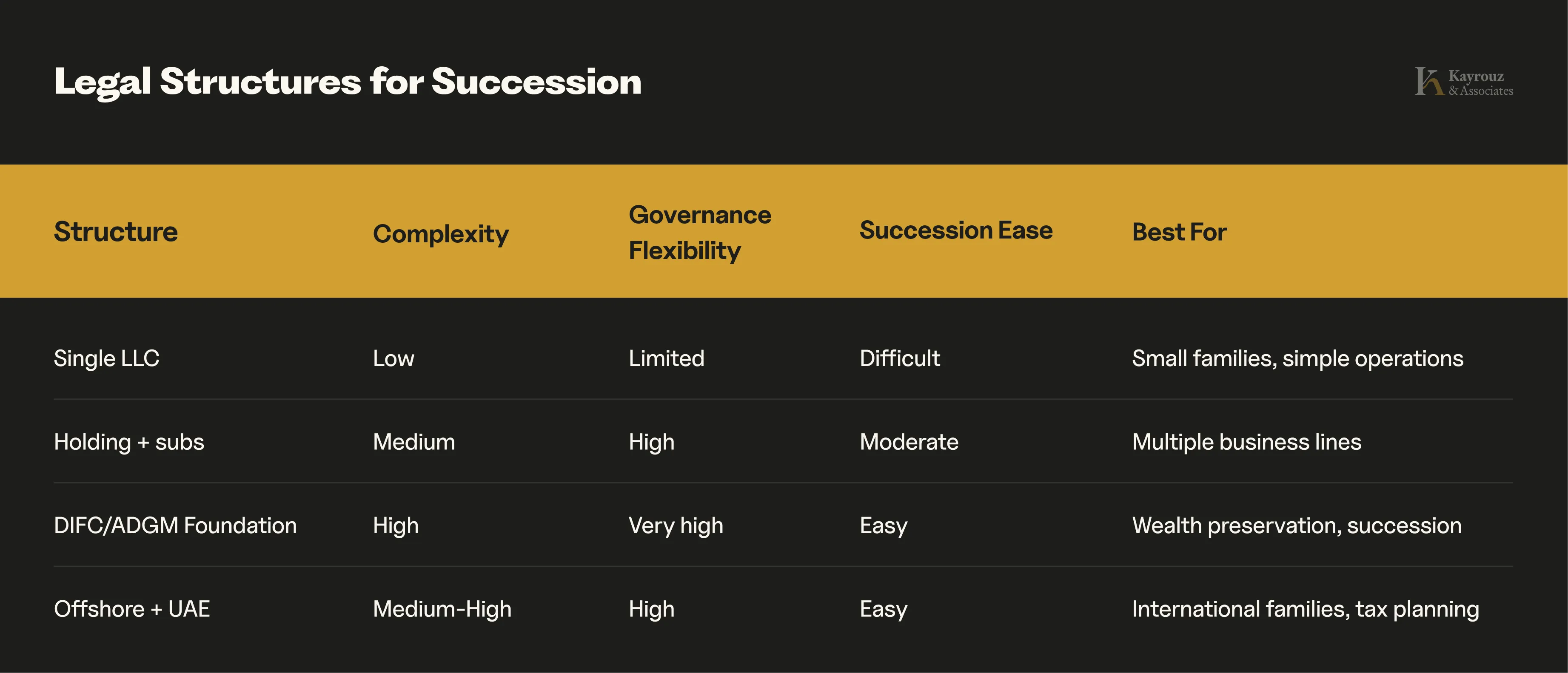
Single UAE LLC works for small families but statutory pre-emption rights can trap minority shareholders.
Holding company structures separate ownership from operations, allowing different share classes and easier transfers.
DIFC and ADGM Foundations are separate legal persons holding assets for beneficiaries. When properly structured, they can provide significant succession flexibility, including the ability to control asset distribution in ways that may not be subject to forced heirship rules, depending on circumstances. Both DIFC Foundations and ADGM Foundations offer options unavailable in UAE mainland structures. Families with significant real estate holdings particularly benefit from foundations.
Offshore structures provide succession flexibility and governance freedom but require meeting substance requirements.
Sharia Inheritance and Business Continuity
For Muslim families, Federal Law No. 28 of 2005 on Personal Status generally mandates specific distribution rules, subject to individual circumstances. Under typical application, sons receive twice daughters' share, surviving spouse receives 1/8 if there are children, and distribution cannot be altered by will (except for up to 1/3 of the estate).
If a founder owning 100% of a business dies, inheritance law will generally require dividing ownership among multiple heirs with different capabilities and involvement levels.
Strategies to preserve business unity: Holding company structures during founder's lifetime with governance documents restricting shareholder interference; buy-sell agreements allowing surviving shareholders to purchase deceased shareholder's shares; life insurance providing liquidity; and DIFC Wills for non-Muslims. Our family law practice coordinates business succession with personal wills.
Common Succession Pitfalls
Starting too late: Founders suddenly realizing they need succession plans discover the next generation is unprepared and governance structures don't exist.
Treating all children equally: Equal ownership can ignore contribution differences and competence levels.
No clear decision-making process: Without defined thresholds, minority shareholders can block progress.
Ignoring minority shareholders: If majority shareholders pay themselves large salaries while distributing minimal dividends, minority shareholders may seek judicial intervention.
No liquidity mechanisms: Family members wanting to exit with no buyout mechanism remain involuntary shareholders, causing friction.
According to PwC's Middle East Family Business Survey, only 33% of family businesses in the region have a robust, documented succession plan. Many pitfalls can be avoided through proactive planning. Our corporate and commercial team implements governance structures and succession roadmaps that prevent these failures. Schedule a consultation to discuss your planning needs.
When Family Disputes Arise
Mediation should precede litigation. Engaging neutral mediators experienced in family business dynamics can resolve conflicts while preserving family bonds.
Shareholder oppression remedies are available under UAE commercial law. Courts can order buyouts, appoint neutral managers, or order winding-up. However, litigation is slow, expensive, and family-destructive.
Buyout mechanisms built into shareholder agreements allow clean exits at market value.
Arbitration clauses allow confidential dispute resolution. For family businesses where confidentiality matters, arbitration through DIAC generally offers more privacy than public court proceedings. Our litigation and dispute resolution team has extensive experience in these sensitive matters.
Is Your Business Ready? Self-Assessment
Answer these questions to evaluate succession readiness:
Governance:
- Do you have a signed shareholders agreement with buy-sell provisions and valuation mechanics?
- Are reserved matters clearly defined (capex thresholds, borrowing limits, dividend policy)?
- Does your board include at least one independent director?
Succession Planning:
- Is there a documented successor development plan?
- Have potential successors worked in the business for multiple years in meaningful roles?
- Do family members understand the difference between ownership rights and management responsibilities?
Financial Structure:
- Is there liquidity planning for passive shareholders?
- Have you addressed Sharia inheritance implications or registered DIFC Wills?
- Does your structure separate ownership from operations?
Legal Documentation:
- Are your constitutional documents aligned with succession plans?
- Do you have life insurance policies to fund buyout obligations?
- Have you established family governance documents?
If you answered "no" to more than three questions, your family business faces elevated succession risk. Contact our team to discuss implementing these protections.
How Kayrouz & Associates Supports Family Succession
Our corporate and commercial team has guided UAE family businesses through generational transitions for nearly two decades.
Succession Planning and Governance
Succession planning workshops: We facilitate family meetings where succession options are explored, family member roles defined, and governance principles established.
Governance structure design: We design three-tier governance (family council, board, management) with clear decision allocation and documentation requirements.
Family constitutions: We prepare family governance documents setting values, mission, entry criteria, and conflict resolution processes.
Legal Restructuring and Documentation
Legal restructuring: We implement optimal entity structures (holding companies, DIFC/ADGM foundations, offshore vehicles) that facilitate succession and provide tax efficiency.
Shareholder agreements: We draft comprehensive agreements addressing buy-sell provisions, valuation mechanics, dividend policies, deadlock resolution, and exit rights.
Constitutional document amendments: We coordinate changes to reflect new ownership structures and governance arrangements.
Cross-Practice Integration
Wills and estate planning: Our family law practice coordinates with estate planning counsel to ensure business succession structures align with personal wills, addressing both Sharia compliance and DIFC Wills.
Employment law matters: When succession involves transitioning family members into or out of management roles, we handle employment contracts, compensation structures, and termination procedures.
Real estate considerations: For families with significant property holdings, we advise on ownership structures and property transfer mechanisms.
Dispute Resolution
Family dispute mediation: When disputes arise, we represent family members in mediation, working to preserve family relationships while protecting client interests.
Shareholder litigation: When mediation proves unsuccessful, we represent family members in shareholder oppression claims and breach of agreement disputes.
Arbitration representation: We handle DIAC arbitrations involving family business disputes.
Buyout negotiations: We advise on and negotiate buyout arrangements including valuation methodology, payment terms, and transition procedures.
Family business succession planning is not a single event but a multi-year process requiring legal, financial, and operational expertise. Contact us to schedule a confidential consultation.
Frequently Asked Questions
Do UAE family businesses need a holding company for succession planning?
Not necessarily. Holding companies provide benefits (separating ownership from operations, enabling different share classes), but they add complexity and cost. The decision depends on family size, business complexity, and succession objectives.
What happens to LLC shares on death under UAE law?
Shares pass to heirs according to applicable inheritance law (Sharia for Muslims, or registered DIFC/ADGM wills for non-Muslims). Existing shareholders may have pre-emption rights. Advance planning through buy-sell agreements and life insurance funding is critical to maintain continuity.
How do you avoid deadlock between siblings in shared leadership?
Deadlock avoidance requires: (1) clear decision-making thresholds in shareholder agreements, (2) defined operational roles so each sibling has authority over their domain, and (3) deadlock resolution mechanisms such as independent director tie-breaking votes or buy-sell provisions.
Can non-Muslim expatriates avoid Sharia inheritance for UAE business assets?
Yes. Non-Muslim expatriates can register wills with DIFC Wills Service Centre or ADGM Wills Service, which applies their home jurisdiction law rather than UAE Sharia inheritance law. This requires proactive registration during the founder's lifetime.
Disclaimer: This article provides general information about family business succession planning in the UAE. It does not constitute legal advice. Family business succession involves complex legal, tax, and personal considerations that vary based on individual circumstances. Consult qualified legal counsel experienced in UAE family business matters for advice regarding your particular situation.
Whether it’s business or personal, our team provides the insight and guidance you need to succeed.