
Construction disputes in the UAE follow predictable patterns. Payment gets withheld. Delays accumulate. Variations go uncertified. By the time parties reach arbitration or court, millions of dirhams and months of project time have been lost.
What separates contractors who recover from those who don't often comes down to one thing: whether they followed the notice requirements in their contract.
This guide explains how FIDIC claims work in the UAE, what the courts require, and what changes in 2026 under Dubai's new construction law.
Why Construction Disputes Escalate
The UAE construction sector continues to grow, with major infrastructure, residential, and energy projects across Dubai, Abu Dhabi, and the Northern Emirates. With that growth comes disputes.
The most common triggers include:
Payment disputes. Delayed interim payments, withheld retention, disputed valuations, and "pay-when-paid" clauses that leave subcontractors waiting indefinitely.
Delay and extension of time claims. Employer-caused delays, late drawings, site access issues, and force majeure events that push completion dates.
Variation disputes. Instructed changes without agreed pricing, scope creep, and disagreements over whether work falls within the original contract.
Defects and decennial liability. Under Article 880 of the UAE Civil Code, contractors and designers are jointly liable for structural defects for 10 years after handover. This cannot be contracted out.
Termination disputes. Wrongful termination claims, disputes over the right to suspend works, and battles over performance guarantees.
FIDIC Contracts: The UAE Standard
Most major construction projects in the UAE use contracts based on the FIDIC suite, published by the International Federation of Consulting Engineers. The most common forms are:
- Red Book (1999/2017): Employer-designed projects. The contractor builds to the employer's design.
- Yellow Book: Contractor-designed projects. The contractor is responsible for design and construction.
- Silver Book: EPC/turnkey projects. The contractor takes on more risk, including for unforeseen conditions.
FIDIC contracts are rarely used unmodified. Employers routinely amend the General Conditions through Particular Conditions that shift risk to contractors. Before signing, contractors should review amendments to delay provisions, limitation of liability, and dispute resolution clauses.
The 28-Day Notice Rule
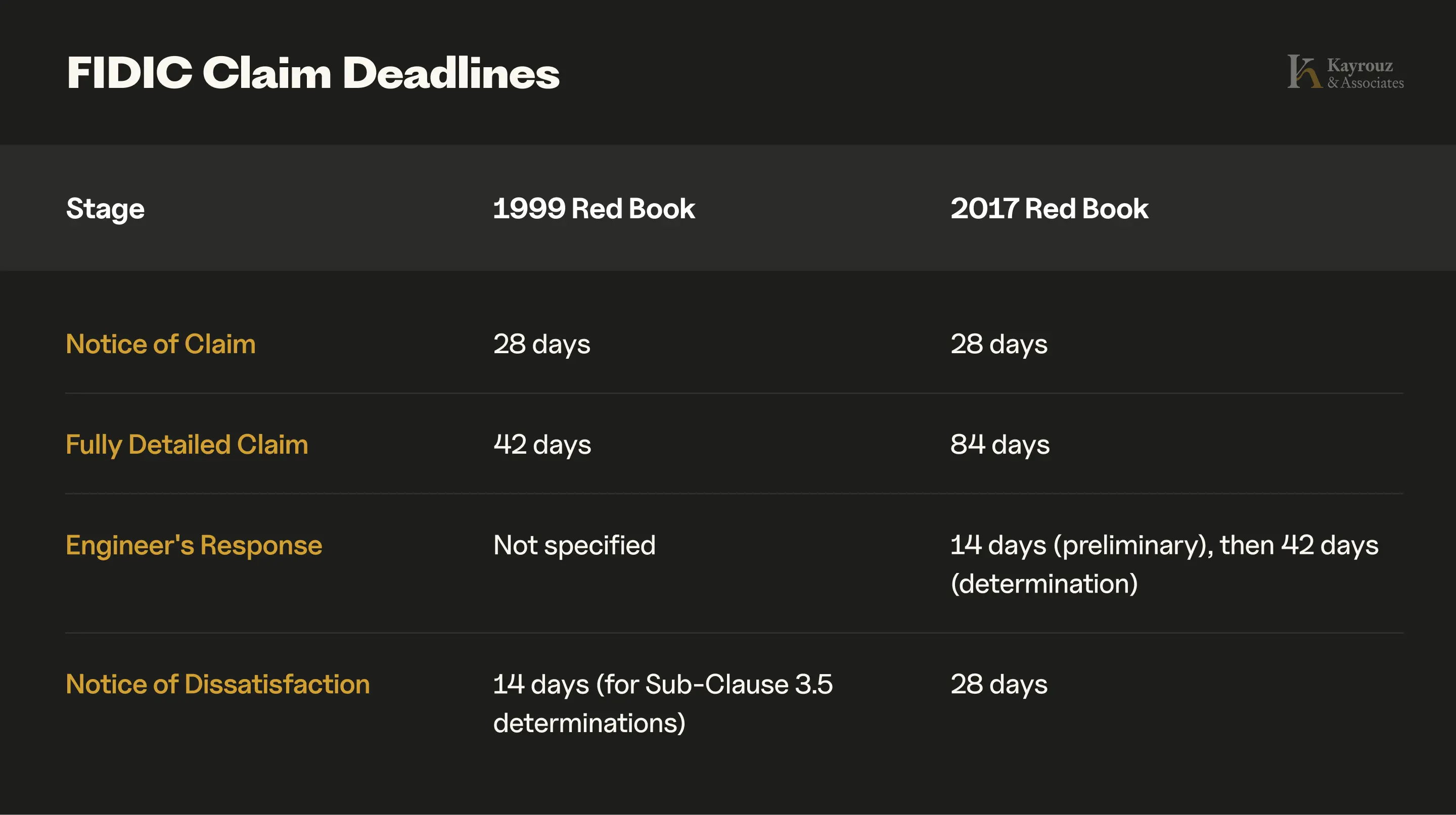
Under FIDIC Sub-Clause 20.1 (1999 edition) or Sub-Clause 20.2 (2017 edition), a contractor seeking an extension of time or additional payment must give notice to the Engineer within 28 days of becoming aware of the event or circumstance giving rise to the claim.
This is not optional. It is a condition precedent. Miss the deadline and the claim is barred.
What the DIFC Courts Say
The DIFC Court of Appeal confirmed this in Panther Real Estate Development LLC v Modern Executive Systems Contracting LLC [2022] DIFC CA 016, decided on 12 May 2023.
In that case, the employer was responsible for 304 of the 325 days of delay. But the contractor had failed to submit timely notices under Sub-Clause 20.1. The Court of Appeal held that the 28-day notice requirement was a clear condition precedent. The contractor lost its entitlement to an extension of time — and became liable for liquidated damages — despite the employer causing most of the delay.
The Court rejected arguments based on good faith under DIFC Contract Law, stating that the contractor was a willing party to a contract that included clear notice requirements. Those requirements would be enforced.
The judgment also addressed when the 28-day clock starts. The Court held that time runs from the date the contractor was aware, or should have been aware, of an event that could give rise to a claim — even if no actual delay had yet occurred. This means contractors must issue notices for prospective delays, not just delays that have already materialised.
A contrasting outcome can be seen in FIVE Real Estate Development LLC v Reem Emirates Aluminium [2020] DIFC TCD 009, where the contractor had consistently sent delay notices throughout the project. The difference in outcome came down to notice discipline.
Practical Guidance
A valid notice does not need to be lengthy. The DIFC Court noted it can be "short and to the point" — even a brief email can suffice, provided it identifies the event, states that the contractor considers it entitled to an extension of time or additional payment, and is sent within 28 days.
The notice should:
- Be in writing
- Describe the event or circumstance giving rise to the claim
- State that the contractor considers itself entitled to an extension of time and/or additional payment
- Be sent to the Engineer (not just the employer's project manager)
Submitting a Fully Detailed Claim
After giving notice, the contractor must submit a fully detailed claim. Under the 1999 edition, this must be done within 42 days of becoming aware of the event. Under the 2017 edition, the deadline is 84 days.
The detailed claim should include:
- A description of the event and its cause
- The contractual basis for the claim (which Sub-Clause applies)
- Supporting records: programmes, correspondence, daily logs, photos
- A delay analysis showing how the event affected the critical path
- Quantum: the extension of time sought and/or the additional payment claimed, with breakdown
If the claim is ongoing, the contractor must submit interim claims at monthly intervals.
FIDIC Claim Deadlines
Dispute Resolution Options
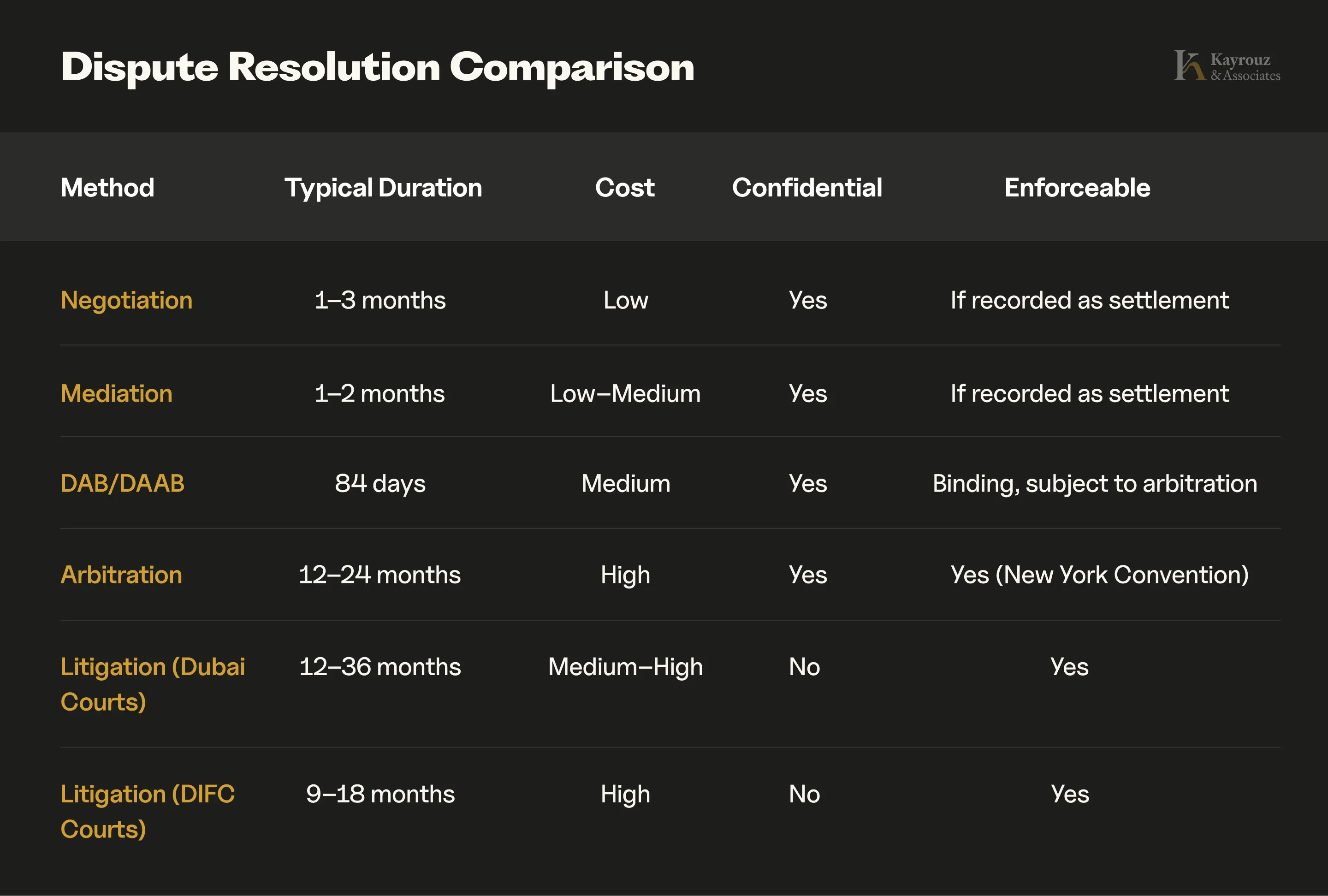
FIDIC contracts provide for a tiered dispute resolution process. Parties are expected to attempt resolution at each level before escalating.
Engineer's Determination. Under FIDIC, the Engineer reviews claims and makes determinations. Parties must challenge adverse determinations within the specified period (14 days under amended Sub-Clause 3.5 in many UAE contracts) or they become final and binding.
Dispute Adjudication Board (DAB/DAAB). FIDIC contracts provide for disputes to be referred to a Dispute Adjudication Board. In the UAE, standing DABs are rarely appointed at contract formation — most parties prefer to appoint an ad hoc board only if a dispute arises. The DAB must issue a decision within 84 days.
Amicable Settlement. After a DAB decision, parties have 28 days (1999 edition) or 28 days (2017 edition) to attempt amicable settlement before proceeding to arbitration.
Arbitration. Most UAE construction contracts refer disputes to arbitration under DIAC (Dubai International Arbitration Centre), ICC (International Chamber of Commerce), or LCIA-DIFC. Arbitration under UAE Federal Law No. 6 of 2018 is governed by the UAE Arbitration Law, which aligns with international best practice.
Litigation. Where contracts are silent on arbitration or specify court jurisdiction, disputes are heard by the Dubai Courts, Abu Dhabi Courts, or (for DIFC-seated contracts) the DIFC Courts. DIFC Courts apply common law principles and are often preferred by international parties.
Dispute Resolution Comparison
Payment Disputes: Contractor Remedies
When payment is withheld, contractors have several options under UAE law and FIDIC.
Suspension of works. Under FIDIC Sub-Clause 16.1, if the employer fails to make payment within 42 days after the due date, the contractor may give 21 days' notice and then suspend work. Where no contractual right exists, contractors may rely on Article 247 of the UAE Civil Code, which permits a party to suspend performance if the other party has failed to perform its obligations.
Caution is required. The Dubai Court of Cassation has held that suspension must be proportionate. If the employer has substantially performed its payment obligations, leaving only a minor amount unpaid, suspension may be found to be in bad faith under Article 246 of the Civil Code.
Precautionary attachment. A contractor can apply to the court for a precautionary attachment order against the employer's assets if there is a risk that those assets may be dissipated. Proceedings must be commenced within eight days of obtaining the order. This remedy has proven effective in encouraging settlement.
Order for payment. For undisputed debts, contractors may seek a summary order for payment, bypassing standard litigation procedures. However, this is only available where the debt is clearly documented and not contested.
Termination. Under FIDIC Sub-Clause 16.2, the contractor may terminate the contract if payment remains outstanding after a prolonged period and notice has been given. Termination is a last resort — it typically ends any prospect of completing the work and recovering anticipated profit.
Delay and Liquidated Damages
Delay liquidated damages (LDs) are enforceable in the UAE. Article 390 of the Civil Transactions Law permits parties to agree compensation in advance. However, courts may adjust the amount if it is excessive relative to the actual loss suffered.
Distinguishing Late Completion from Non-Completion
Delay LDs apply when the contractor completes late. If the contractor fails to complete at all (non-completion), the employer's remedy is damages for breach of contract, not delay LDs. The distinction matters for quantum.
Concurrent Delay
Where both employer and contractor cause delay to the same critical path activity during the same period, the question of entitlement becomes complex. The UAE has no statutory rule on concurrent delay. The Society of Construction Law Delay and Disruption Protocol (2nd edition) is increasingly referenced in arbitration as a guide to best practice.
What Changes in 2026
Two significant pieces of legislation take effect in January 2026.
Dubai Law No. 7 of 2025: Contractor Registration
Dubai Law No. 7 of 2025 introduces a unified regulatory framework for all contractors operating in Dubai, including those in free zones and the DIFC. Key requirements:
- Mandatory registration with the Dubai Municipality contractor register
- Classification based on financial capacity, technical capability, and experience
- Subcontracting controls: prior approval is now required before subcontracting
- Document retention: all project documents must be retained for 10 years after completion
- Penalties: fines of AED 1,000 to AED 100,000, doubling for repeat violations; suspension of up to one year; downgrading of classification
Contractors have until 8 January 2027 to regularise their status. The 10-year document retention requirement will affect evidence preservation in future disputes.
For a detailed breakdown, see our guide: Dubai's New Construction Law 2025 Explained.
Dubai Law No. 8 of 2025: Citizens' Home Disputes
Dubai Law No. 8 of 2025 establishes a dedicated branch under the Centre for Amicable Settlement of Disputes to handle disputes arising from contracts for the construction of UAE nationals' homes, where the dispute value does not exceed AED 10 million.
This law applies specifically to home construction contracts for citizens. It does not change dispute resolution for commercial construction or projects involving non-nationals. Disputes covered include variation orders, withheld payments after completion, delays, and design or execution errors.
Protecting Your Position: A Pre-Dispute Checklist
Contractors and employers can reduce dispute risk and improve their position if a dispute arises by following these practices:
1. Issue notices on time. Every time. The Panther case demonstrates the cost of failure. A short email within 28 days is better than a detailed letter on day 29.
2. Maintain contemporaneous records. Daily site logs, progress photos, correspondence registers, programme updates, and signed delivery notes. Courts and tribunals give significant weight to records created at the time.
3. Follow the contractual claims procedure. Submit fully detailed claims within the required period. Respond to Engineer's determinations within the specified timeframe.
4. Retain documents for 10 years. This is now a legal requirement under Law No. 7 of 2025. Even before the law, the decennial liability period under Article 880 made long-term retention essential.
5. Review arbitration clauses carefully. The Dubai Court of Cassation has held that incorporating FIDIC's arbitration clause by general reference (rather than expressly setting it out) may not be sufficient to oust court jurisdiction. If arbitration is intended, the clause should be express and detailed.
6. Engage legal counsel early. For high-value variations, potential termination, or disputes involving significant delay, legal advice at an early stage can prevent procedural errors that foreclose claims later.
How Kayrouz & Associates Can Help
Kayrouz & Associates has a dedicated Construction Law team with experience across major infrastructure, residential, and energy projects in the UAE and the Middle East. Our services include:
- Contract review and negotiation: Identifying risk allocation issues in FIDIC and bespoke contracts before signature
- Claims management: Advising on notice requirements, preparing delay analyses, and drafting detailed claims
- Dispute resolution: Representation in DIAC, ICC, and LCIA-DIFC arbitrations, Dubai Courts, Abu Dhabi Courts, and DIFC Courts
- Regulatory compliance: Advising on Law No. 7 of 2025 registration and classification requirements
Our team combines construction law expertise with practical project experience. We advise contractors, employers, developers, and consultants across the project lifecycle.
For a related analysis of recent case law, see: Abu Dhabi Cassation Court Ruling: Key Takeaways for Property Owners and Contractors.
Whether it’s business or personal, our team provides the insight and guidance you need to succeed.