
The UAE represents one of the most attractive medical device markets in the Middle East, with projected growth from USD 3.18 billion in 2025 to USD 4.71 billion by 2032. This 5.8% compound annual growth rate reflects sustained government investment in healthcare infrastructure, an aging expatriate population with high expectations for quality care, and the nation's strategic ambition to rank among the world's top 15 healthcare systems by 2031.
For medical device manufacturers, distributors, and investors evaluating market entry, the UAE offers compelling commercial potential alongside a regulatory environment that rewards thorough preparation and strategic planning.
Understanding the Regulatory Landscape
The Ministry of Health and Prevention (MoHAP) regulates medical devices in the UAE through the Drug Control Department, operating a framework that shares conceptual foundations with European and FDA regulatory models while maintaining distinct local requirements.
Registration is mandatory. No medical device may be imported, distributed, marketed, or sold in the UAE without prior MoHAP approval.
Consequences of non-compliance include:
- Detention of unregistered devices at ports of entry
- Seizure of products already in the supply chain
- Prohibition from the UAE market
- Financial penalties for distributors
- Potential license suspension for repeat violations
The Commercial Reality of UAE Market Entry
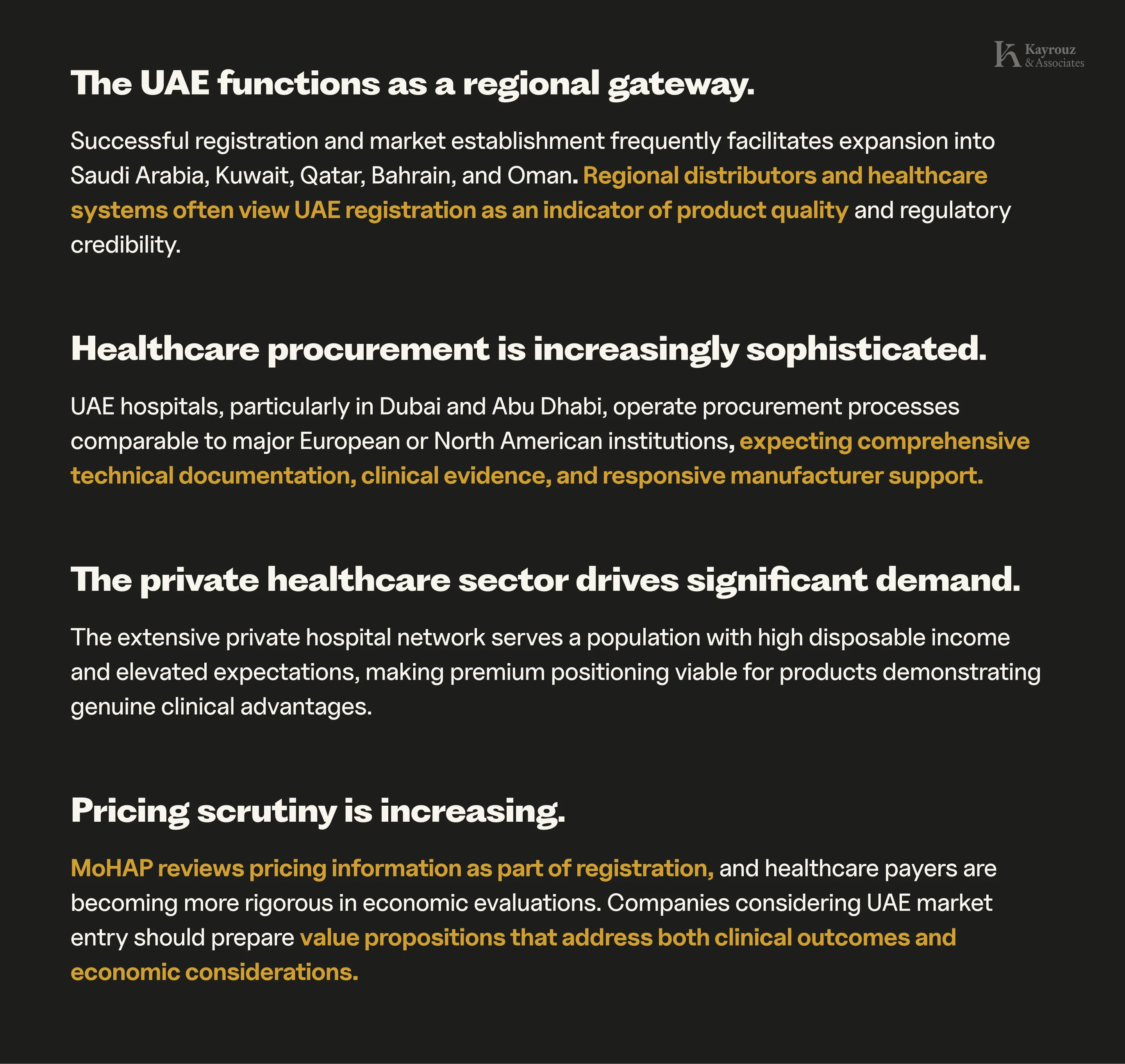
Before examining procedural requirements, companies should understand several commercial factors that shape registration strategy.
Who Bears Registration Responsibility
The regulatory framework assigns specific responsibilities to different participants in the supply chain.
Selecting the Right Local Partner
The choice of authorised representative ranks among the most consequential decisions in UAE market entry. A capable local partner provides:
- Regulatory intelligence regarding evolving MoHAP requirements
- Market insight on competitive dynamics and customer preferences
- Logistics infrastructure for efficient distribution
- Commercial capabilities for effective market development
- Shared reputational accountability if product issues arise
Partner evaluation criteria should include:
- Regulatory track record and MoHAP relationships
- Existing portfolio composition (including potential conflicts)
- Facility capabilities and geographic coverage
- Financial stability and investment capacity
- Commercial resources and healthcare sector relationships
Companies seeking guidance on structuring commercial relationships in the UAE should consult with legal advisors experienced in healthcare regulatory matters.
Device Classification System
The UAE follows the Global Harmonization Task Force (GHTF) classification system, categorizing devices by risk level. The UAE medical device classification rules align with the classification rules of the EU Medical Device Directives.
In Vitro Diagnostic Devices (IVDs)
IVDs are similarly classified by risk into four tiers:
- Class A – Low risk
- Class B – Low to moderate risk
- Class C – Moderate to high risk
- Class D – High risk
Classification Strategy Considerations
Device classification is not always straightforward. Products requiring careful analysis include:
- Devices combining multiple functions
- Products incorporating novel technologies
- Devices with ambiguous intended use statements
- Combination products (device + drug or biologic)
MoHAP has introduced an official classification service, particularly useful when manufacturers are unsure whether their product requires registration. The classification letter indicates whether a product needs to be registered and, if so, according to which class. This letter is valid for three years from the date of issue.
The Registration Process
Preparation and Site Registration
Before any product application can proceed, foreign manufacturers must complete site registration with MoHAP.
Site registration requirements:
- Valid ISO 13485:2016 certificate (legalized by UAE Embassy)
- Legalized valid business/manufacturing license from country of origin
- List of products manufactured and/or assembled by the site
- Detailed company profile
- Site Master File
- Certified copies of GMP certificates from other countries
Documentation Assembly
The documentation package must be comprehensive, precisely formatted, and internally consistent.
Submission and Review
The review process follows a structured sequence:
- System Access. Login to MoHAP website or smart app using UAE PASS
- Application Submission. Submit through e-service platform with applicable fees
- Technical Committee Review. Evaluation against regulatory standards
- Information Requests. Respond to clarification queries (common occurrence)
- Ministerial Committee Review. Final determination based on technical recommendations
- Decision Notification. Official correspondence with approval, deferral, or rejection
Approval and Certificate Issuance
Upon successful review, MoHAP issues a device registration certificate valid for five years from committee approval, authorizing importation, distribution, and sale in the UAE market. Renewal must be completed before expiration following the same procedures.
Documentation Deep Dive
Documentation deficiencies represent the primary source of registration delays and failures. MoHAP reviewers are technically sophisticated and examine submissions with considerable rigor.
Common Documentation Deficiencies
- Incomplete device descriptions failing to address all aspects of intended use
- Insufficient biocompatibility data for patient-contacting devices
- Inadequate software documentation for devices with embedded software
- Missing or outdated risk management files (should align with ISO 14971)
- Clinical evidence not adequately supporting claimed intended use
- Poor-quality Arabic translations
Authentication and Legalization
Certificates from foreign regulatory authorities must be authenticated through appropriate governmental channels.
Typical authentication pathway:
- Notarization in country of origin
- Authentication by manufacturer's national authorities
- Legalization by UAE Embassy in country of origin
- Final authentication by UAE Ministry of Foreign Affairs (if required)
Arabic Translation Standards
All patient-facing materials must be provided in Arabic alongside English. Professional medical translation services with UAE market experience are essential; machine translation is wholly inadequate for this purpose. Companies operating in the UAE should be aware of compliance requirements that extend beyond registration documentation.
Timeline and Investment Considerations
Realistic Timeline Expectations
Companies planning market entry around specific commercial dates should initiate registration significantly earlier than published timelines suggest.
Additional Investment Considerations
Beyond MoHAP fees, budget for:
- Documentation preparation and gap remediation
- Certificate authentication and legalization
- Professional Arabic translation services
- Regulatory consulting fees
- Local partner/MAH engagement costs
- Import permit fees for each consignment
What Experienced Companies Know
Companies that have successfully navigated UAE registration consistently emphasize several practical realities.
First Registration Versus Portfolio Expansion
Listing vs. Full Registration
MoHAP provides two pathways depending on device risk:
Listing Route (Low-Risk Devices):
- Applicable to Class I medical devices and devices used in hospitals under professional supervision
- Simplified evaluation process
- Upon approval, a Listing Certificate is issued
- Import permit still required to market the device
Full Registration Route:
- Required for Class II, III, and IV devices
- Detailed technical evaluation
- Registration certificate valid for five years
Post-Approval Obligations
Registration initiates an ongoing relationship with substantial regulatory obligations.
Continuing requirements include:
- Adverse event reporting within specified timeframes
- Post-marketing surveillance reports every 2 years (Class III/IV)
- Vigilance system maintenance
- Registration renewal every 5 years
- Documentation updates as required
- Import permit for each consignment
Failure to meet post-marketing obligations can result in registration suspension or revocation. Companies should ensure their corporate governance structures support ongoing compliance activities.
Common Challenges and Solutions
Strategic Considerations for Market Entry
Portfolio Prioritization Framework
When registering multiple products, consider:
- Revenue potential: Which products offer the strongest UAE market opportunity?
- Competitive urgency: Are competitors establishing presence with similar products?
- Registration complexity: Which products can establish institutional competence?
- Clinical reference value: Which products can generate influential case studies?
- Strategic relationships: Which products open doors with key customers?
Registration and Commercial Integration
The most effective market entry approach integrates regulatory and commercial strategy from the outset. Companies should also consider the broader UAE free zone landscape when planning their operational structure.
Parallel workstreams should include:
- Registration preparation and submission
- Customer relationship development
- Clinical reference site identification
- Market awareness building
- Distribution network establishment
- Tender cycle mapping
How Kayrouz & Associates Supports Medical Device Companies
Kayrouz & Associates brings nearly two decades of UAE legal experience to medical device companies navigating the regulatory landscape.
Our healthcare regulatory services include:
- Regulatory Strategy Development — Market opportunity evaluation, pathway assessment, registration planning
- Registration Support — Documentation guidance, MoHAP coordination, issue resolution
- Local Partner Evaluation — Identification, due diligence, and relationship structuring
- Compliance Advisory — Post-marketing obligations, regulatory changes, compliance maintenance
- Commercial Transactions — Distribution agreements, licensing arrangements, joint ventures
Since 2006, we have successfully resolved more than 570 matters across diverse practice areas, consistently delivering outcomes that serve our clients' strategic interests. Our team also advises on related matters including healthcare facility licensing and dispute resolution.
Begin Your UAE Market Entry
The UAE medical device market offers genuine commercial opportunity for manufacturers prepared to invest in proper regulatory compliance and market development.
Schedule a consultation with our healthcare regulatory team to discuss your specific situation and receive strategic guidance tailored to your objectives.
Kayrouz & Associates maintains offices in the UAE and serves clients throughout the Middle East region. This guide provides general information regarding UAE medical device registration and should not be construed as legal advice applicable to any specific situation.
Your success starts with the right guidance.
Whether it’s business or personal, our team provides the insight and guidance you need to succeed.