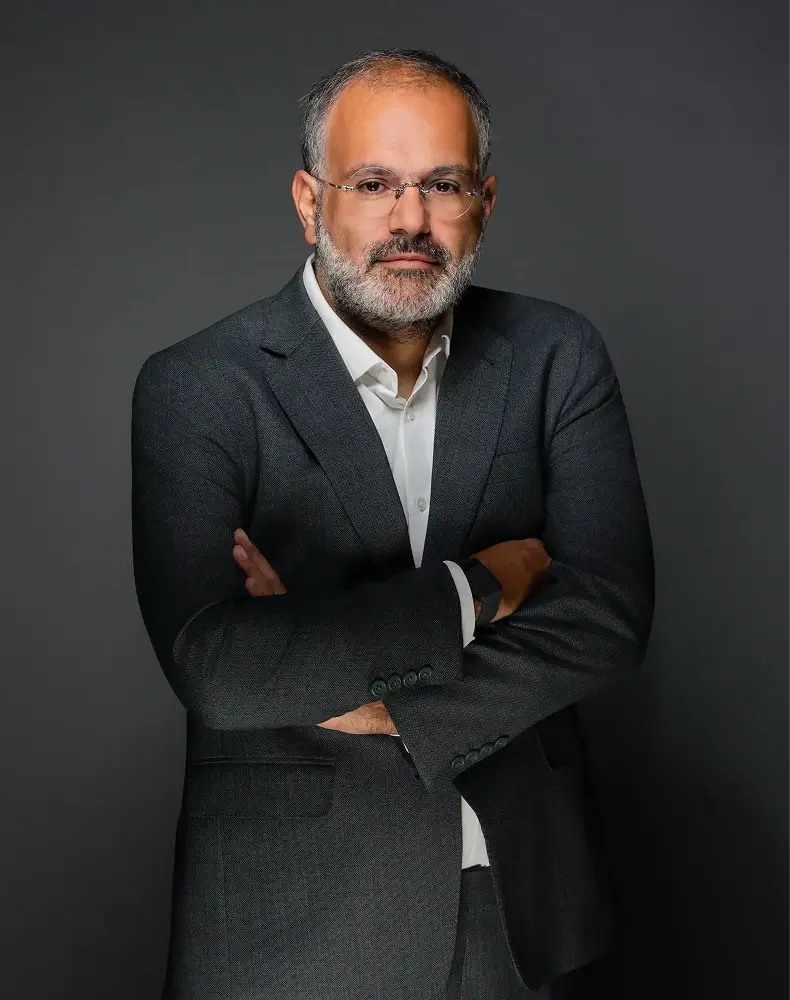
Pierre Kayrouz is the founder of Kayrouz & Associates and a senior litigator and arbitrator with more than twenty-four years of experience in complex disputes across the UAE. He acts for multinational corporations, institutional clients, and individuals, with a practice centred on construction and infrastructure disputes.
Pierre represents clients before the UAE courts and the region's major arbitration centres, including the DIFC, DIAC, the ICC, and the LCIA. He handles construction defects, delay and disruption claims, bond calls, land acquisition, and contractual enforcement, supported by experience across real estate, civil, commercial, property, and environmental law.
He also advises on liability assessments involving insurers and third-party subcontractors, and on matters arising from injuries and fatalities on construction sites. His work is built on close case analysis, precise pleadings, and a practical approach to resolving disputes.
Alongside his client work, Pierre mentors the firm's junior lawyers and sets its litigation and arbitration strategy, reinforcing the firm's standing as a leading disputes practice in the region.
Core Responsibilities
- Facilitating client communication and service coordination
- Managing administrative workflows and supporting legal teams
- Ensuring smooth interdepartmental collaboration
- Representing the firm in client-facing engagements with professionalism and care
Areas of Practice
Arbitration
Litigation and dispute resolution
Corporate and commercial
Real estate
Construction
Core Responsibilities
- Facilitating client communication and service coordination
- Managing administrative workflows and supporting legal teams
- Ensuring smooth interdepartmental collaboration
- Representing the firm in client-facing engagements with professionalism and care
Qualifications
Admissions
Admitted to practice in the United Arab Emirates and Egypt.
Academic
- Bachelor’s Degree in Law, Lebanese University, 2000
- Master’s Degree in International Law and Legal Studies, Université Paris 1 Panthéon-Sorbonne, 2021
- Bachelor of Laws (LLB), Personal Status Law, City University Ajman, 2020
- High School Diploma, Collège des Frères Mont La Salle, 1995
Licenses & Certifications
- Rédaction de contrats – Université de Genève, GSI, Issued May 2020
- Framing Your Communication to Inspire and Convince – TU Delft, Issued Apr 2020
- Successful Negotiation: Essential Strategies and Skills – University of Michigan, Issued Apr 2020
- Contract Law: From Trust to Promise to Contract – HarvardX, Issued Mar 2020
Languages
Related News
.jpg)
How do you challenge an arbitral award in the UAE courts?
An action to annul an onshore arbitral award must be brought within 30 days of notification, and Article 53 lists the eight grounds the challenging party has to prove. Nullity can also be raised as a defence to recognition, which carries no deadline, and a DIFC-seated award follows a separate route the DIFC Courts used for the first time in April 2026.

Can a UAE court reduce a demurrage invoice?
Demurrage and detention are contractual charges, so the entitlement comes from the charterparty or the bill of lading rather than from the Maritime Law. Since 1 June 2026 a party invoiced can ask the court to reduce an amount it proves is exaggerated, or one the carrier's own delay helped cause.


Multiple authorised agents for medical products in the UAE
The EDE activated a mechanism in February 2026 requiring more than one authorised agent per medical product. Registered commercial agents still hold statutory exclusivity, and this guide sets out the three routes to adding a second agent and what each one costs.


UAE Economic Substance Regulations (ESR) 2026
Cabinet Decision 98 of 2024 cancelled UAE Economic Substance notifications and reports for financial years ending after 31 December 2022. The regime still governs the historical period from 2019 to 2022, where unfiled returns and penalties remain live. The substance test itself now sits inside corporate tax, where a Qualifying Free Zone Person must show adequate UAE substance for the 0 per cent rate.