The UAE logistics sector handled 15.5 million TEUs through Jebel Ali Port and 2.2 million tonnes of air cargo through Dubai airports in 2024 (Maritime Gateway), yet many logistics operators discover their contracts are unenforceable only when disputes arise. Commercial contracts form the foundation of logistics operations, determining liability exposure, payment security, and dispute resolution options.
Whether operating freight forwarding businesses, managing warehouses, or providing last-mile delivery services, the agreements logistics companies sign with customers, carriers, and suppliers require careful drafting to withstand UAE legal scrutiny. We regularly see six and seven-figure exposure when limitation clauses fail to meet UAE requirements or when warehouse agreements lack proper security provisions for unpaid fees.
This guide examines essential contracts logistics companies need, drafting requirements under UAE law, and common mistakes that make agreements unenforceable. With the Federal Decree-Law concerning Maritime Law (effective 29 March 2024), Federal Law No. 5 of 1985 (Civil Transactions Law), and specific Dubai regulations governing logistics operations, UAE contract requirements differ substantially from international standards.
Following your logistics company setup in Dubai, establishing proper contractual frameworks protects your business from liability exposure and ensures payment security.
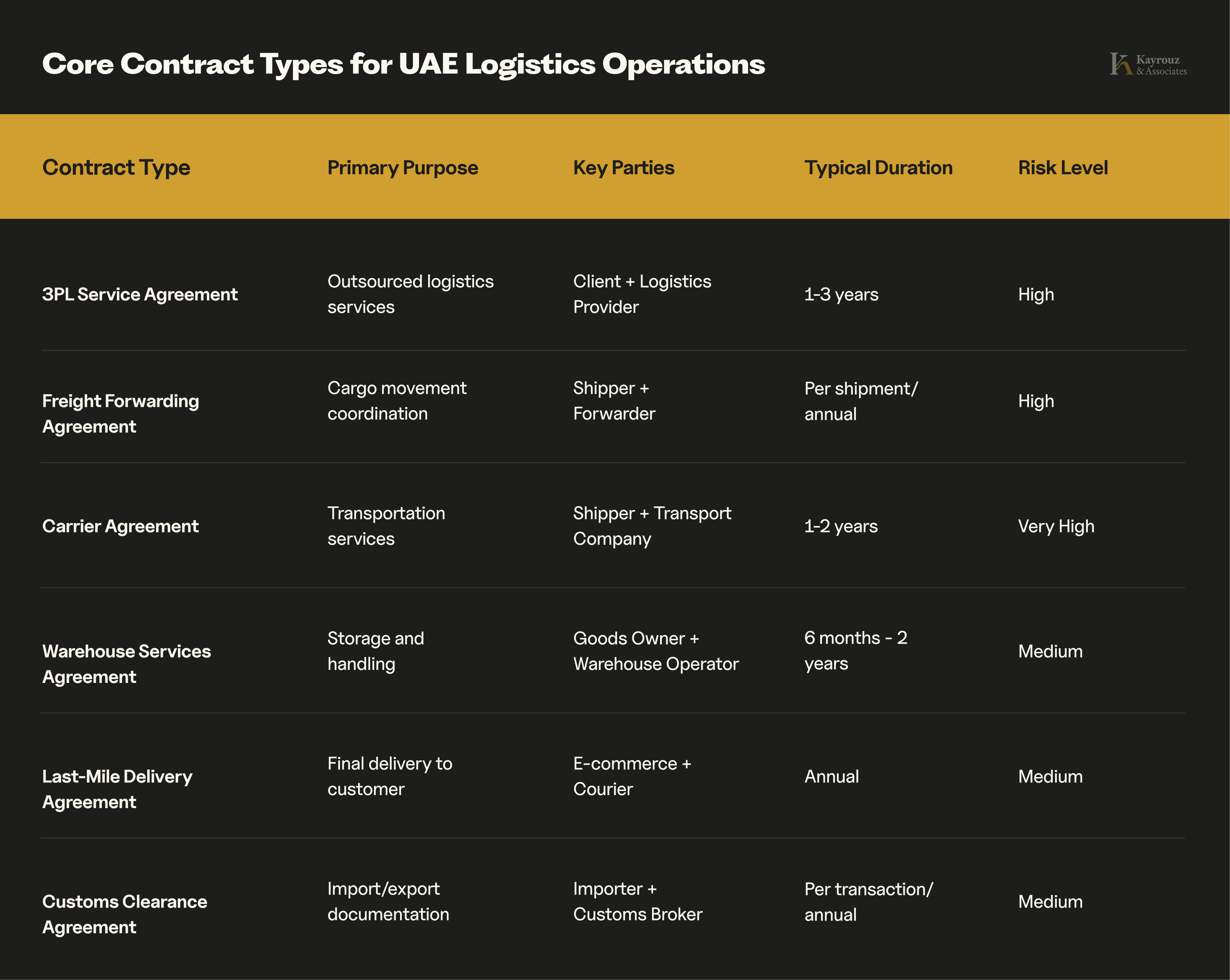
Essential Logistics Contracts: Types and Functions
Core Contract Types for UAE Logistics Operations
When Carrier Liability Clauses Actually Work
Most logistics contracts copy liability clauses from international templates without understanding what Dubai Courts enforce. Here's what actually happens:
The Reality of "We Limit Liability to AED 100/kg"
A freight forwarder included standard liability language limiting damages to AED 100 per kilogram. When AED 380,000 worth of electronics were damaged, the shipper sued for full value. The forwarder pointed to their limitation clause. Dubai Courts examined how the clause was presented and found it buried in paragraph 18 of standard terms, printed in 8-point font, never specifically discussed during contract negotiation. The court ignored the clause entirely. The forwarder paid AED 380,000 plus legal fees.
What works instead: Liability limitations in UAE logistics contracts need three elements to survive court scrutiny. First, prominence. Bold text, separate section, ideally a signature line specifically acknowledging the cap. Second, reasonableness relative to the service. A AED 5,000 freight charge with AED 50 liability cap won't survive. Third, insurance coordination. If you're capping liability at AED 100/kg, the contract should explicitly state this reflects available insurance coverage and recommend the shipper obtain additional coverage for high-value cargo.
Maritime Transport
The Federal Decree-Law concerning Maritime Law (effective 29 March 2024) governs sea freight. Bills of lading issued after March 2024 fall under the new framework, which incorporates limitation principles familiar from international conventions but applies them within UAE's legal structure.
Practical impact: Your bill of lading terms can limit liability, but UAE courts will scrutinize whether limitations were adequately communicated and whether they're unconscionable given the cargo value. International limitation formulas (SDR per package or per kilo) are recognized, but presentation matters. The shipper needs to understand they're accepting limited liability, ideally through explicit cargo value declaration processes.
Road Transport
Many logistics contracts reference CMR Convention for road transport. This doesn't work. The UAE is not a contracting party to CMR as of 15 January 2026. If you're relying on CMR liability limits for cross-border trucking to Saudi or Oman, your contract provides no protection.
What to do: Draft specific liability provisions for road transport. State liability limits explicitly (e.g., AED 200 per kilogram or 10x freight charges, whichever is less). Include insurance requirements. Document that shipper had opportunity to declare higher value and pay additional charges. The contract itself must create the liability framework; you can't outsource it to an international convention UAE hasn't adopted.
Air Cargo: The 26 SDR Update
Montreal Convention governs international air cargo with liability at 26 SDR per kilogram (increased from 22 SDR effective 28 December 2024). This applies automatically for international air shipments. However, many freight forwarders handle multi-leg shipments where air is one segment.
The problem: Your contract might reference "air transport rates" without specifying which leg. If your standard terms state "liability limited per Montreal Convention" but the loss occurs during road transport to/from the airport, you've created ambiguity. Dubai Courts interpret ambiguities against the party who drafted the contract (the logistics provider).
Better approach: Segment liability by transport mode. "For air transport segments, liability is limited to 26 SDR per kilogram per Montreal Convention. For road transport segments, liability is limited to AED 200 per kilogram. Customer may declare higher value and pay supplementary charges."
What 3PL Contracts Actually Need
The difference between enforceable 3PL agreements and ones that fail comes down to specificity in four areas: service scope, liability allocation, payment security, and exit procedures.
Service Scope: The AED 180,000 "That's Not Included" Dispute
A 3PL provider contracted to handle "warehousing and distribution" for an e-commerce client. Six months in, the client demanded the 3PL handle product returns, repackaging, and customer service for returned items. The 3PL refused, stating these weren't included. The client withheld AED 180,000 in fees, claiming essential services weren't provided.
The contract stated: "Provider will perform warehousing, order fulfillment, and distribution services as reasonably required for Client's e-commerce operations."
The problem: "Reasonably required" is a lawyer's paradise and an operator's nightmare. The court sided with the client, reasoning that returns are inherent to e-commerce operations and the contract's broad language encompassed them.
How to draft service scope properly:
Included Services (Exhaustive List):
- Receiving: Unload containers, count pallets, scan barcodes into WMS
- Storage: General dry storage at ambient temperature (18-25°C)
- Picking: Retrieve items per daily pick lists provided by Client
- Packing: Pack items in Client-supplied packaging materials
- Shipping: Generate airwaybills, coordinate courier pickup
- Reporting: Daily inventory report, weekly fulfillment metrics
Explicitly Excluded Services:
- Returns processing (requires separate returns handling agreement)
- Kitting or assembly of products
- Quality inspection beyond count verification
- Customer service or communication
- Temperature-controlled storage
- Refrigerated transport
Notice the difference? Every service includes what's actually performed. Exclusions are specific, not "services not expressly listed." This prevents the "reasonably required" interpretation that cost the 3PL in the example.
Performance Metrics
Most 3PL contracts include SLAs like "99% order accuracy." Sounds precise. In practice, it's useless without defining how accuracy is measured.
Actual SLA language that works:
"Order accuracy is measured as correctly picked and shipped orders divided by total orders. An order is considered accurate if: (1) all items match the pick list, (2) quantities are correct, and (3) items are undamaged. Accuracy is calculated weekly based on customer-reported discrepancies received within 7 days of delivery. Target: 99.5% monthly rolling average. Failure to meet target for two consecutive months triggers price reduction of 5% for affected period. Failure for three consecutive months provides Client termination right with 30-day notice."
Why this works: It defines what's measured, when it's measured, who reports discrepancies, and what happens when SLAs fail. Generic SLA language creates disputes about measurement methodology when performance problems arise.
The Payment Security Problem
You provide warehousing services worth AED 50,000 monthly. Your customer has AED 2.3 million worth of inventory in your warehouse. What happens when they stop paying?
Standard contract approach: "Payment due within 30 days. Late payments accrue interest at 2% monthly."
What actually happens: Customer stops paying in month 4. You're owed AED 200,000. You have their inventory. Under UAE law, you have possessory lien rights, but exercising them requires formal notice, opportunity to cure, and compliance with specific procedures. Meanwhile, you're providing storage services you're not getting paid for, and you can't simply throw their goods out.
Better contract drafting includes:
Security for Payment: "If Client's payment is overdue by more than 15 days, Provider may: (1) cease providing services until payment received, (2) refuse to release inventory, (3) exercise possessory lien rights per UAE law. Provider will provide 7 days' written notice before exercising these rights."
Lien Exercise Procedure: "Provider's possessory lien covers all amounts due. If payment is not received within 30 days of written notice, Provider may sell inventory at public or private sale after providing 15 days' notice of sale. Sale proceeds applied first to outstanding fees, then storage costs during non-payment period, then legal costs. Any surplus returned to Client."
Advance Payment Option: "For clients without established payment history, Provider may require advance payment for first three months' services plus security deposit equal to one month's estimated fees."
This transforms payment terms from wishful thinking into enforceable security. We've recovered AED 1.2 million for a warehouse operator using these mechanisms.
Why Termination Sections Actually Matter
A 3PL relationship ends. The question is whether it ends cleanly or becomes a six-month nightmare where the client's inventory is held hostage while both sides threaten litigation.
The transition provisions that work:
Notice Period: "Either party may terminate with 120 days' written notice. During notice period, Provider continues all services at contracted rates. Client may not remove inventory until final payment received."
Inventory Transition: "Upon termination, Provider will conduct joint inventory count with Client. Discrepancies resolved per Section 8. Client arranges pickup within 15 days of termination date. Provider may charge daily storage fees at 150% of contracted rate for inventory remaining beyond 15 days."
Data and Systems: "Provider provides Client with final inventory export in CSV and PDF formats. Access to Provider's WMS terminates on termination date. Provider retains records per UAE requirements but has no ongoing reporting obligations."
Outstanding Amounts: "All outstanding fees due immediately upon termination. Provider exercises possessory lien per Section 6 until payment received."
Post-Termination Non-Solicitation: "For 12 months following termination, Client will not directly solicit or hire Provider's warehouse employees who worked on Client's account."
These provisions prevent the common pattern where clients try to drag out transition to avoid final payment, or attempt to poach the warehouse staff who know their operations.
Customs Clearance: Where Most Contracts Are Silent
Freight forwarders handle customs clearance daily. Yet most freight forwarding agreements barely address customs beyond stating "we'll handle clearance."
The AED 85,000 Penalty
A freight forwarder cleared an electronics shipment through Dubai Customs. The importer had provided a commercial invoice declaring value of AED 120,000. Dubai Customs conducted a post-clearance audit and determined actual value was AED 280,000. Dubai Customs assessed penalties of AED 85,000 for incorrect declaration.
The question: Who pays the AED 85,000?
The contract stated: "Forwarder will handle customs clearance based on documentation provided by Shipper."
What happened: The freight forwarder argued they relied on the shipper's documents. The shipper argued the forwarder has professional expertise to identify valuation issues. Without clear contractual allocation of this risk, both sides incurred legal fees arguing about a penalty that could have been addressed in contract drafting.
How to address customs penalties contractually:
Documentation Accuracy: "Shipper represents and warrants that all customs documentation provided to Forwarder accurately reflects goods description, value, origin, and classification. Shipper is solely responsible for accuracy of declarations."
Forwarder's Verification Limits: "Forwarder's obligation is limited to submitting documentation as provided. Forwarder does not independently verify declared values, classifications, or origins unless Shipper specifically requests verification services at additional cost."
Penalty Allocation: "Shipper indemnifies Forwarder for all customs penalties, duties, and fines arising from inaccurate documentation provided by Shipper. If penalties arise from Forwarder's submission errors, Forwarder is responsible. If penalties arise from documentation accuracy issues, Shipper is responsible."
Under Dubai Customs regulations, penalties for incorrect declarations range from AED 1,000 for minor violations to significant amounts for valuation discrepancies or prohibited goods. Clear contractual allocation prevents disputes about who bears these costs.
Power of Attorney Scope: "Shipper grants Forwarder limited power of attorney solely for submitting customs declarations and representing Shipper before Dubai Customs for clearance purposes. This power of attorney does not authorize Forwarder to make commitments regarding Shipper's future import practices or compliance programs."
This language saved a forwarder from paying AED 120,000 in penalties when customs found classification errors in shipper-provided documentation.
Force Majeure: The Post-COVID Reality
Generic force majeure clauses failed completely during COVID-19. Courts asked: Does "acts of God" include pandemics? Does "government action" include voluntary business closures? Are you required to find alternative transportation if borders close?
Contract language that actually worked during COVID:
"Force majeure includes: (1) pandemics, epidemics, or public health emergencies declared by WHO or UAE government, (2) government-mandated closures of ports, airports, or borders, (3) quarantine restrictions preventing movement of goods or personnel, (4) closure of transportation routes due to government order.
Party claiming force majeure must: (1) provide written notice within 48 hours of force majeure event, (2) describe specific impact on performance, (3) demonstrate reasonable efforts to mitigate, including sourcing alternative carriers, routes, or facilities.
Force majeure suspends performance obligations but does not eliminate them. Affected party must perform to maximum extent possible. If goods are in warehouse when force majeure occurs, storage fees continue at 50% of contracted rate. If force majeure prevents delivery for more than 60 days, either party may terminate upon 15 days' notice."
Why this worked: Specific events, immediate notice requirement, partial performance obligations, and realistic termination timeline. Compare to "acts of God excuse performance" which created months of litigation about whether COVID qualified.
Free Zone Movements and Cross-Border Operations
The AED 65,000 "We Didn't Know It Was Re-Export Only" Problem
A logistics provider stored goods for a client in JAFZA warehouse. Six months later, the client wanted to sell goods in UAE mainland. The logistics provider arranged mainland delivery. Dubai Customs assessed AED 65,000 in duties and penalties because goods entered free zone under re-export status and couldn't be cleared for domestic consumption without proper procedures.
The contract said nothing about free zone restrictions.
How to address this:
Free Zone Status: "Goods stored in JAFZA warehouse [specify warehouse location] are in UAE Free Zone. Goods may be: (1) re-exported internationally, (2) moved to other UAE free zones, or (3) cleared for UAE mainland consumption if Client obtains proper import permits and pays all applicable customs duties."
Client's Re-Export Commitment: "Client represents that goods are intended for [re-export / mainland clearance]. If Client subsequently changes intended use, Client is responsible for all customs procedures, duties, and penalties."
Provider's Customs Facilitation: "Provider will facilitate customs clearance if Client requests mainland delivery, but Client is responsible for all duties, fees, and providing required documentation. Provider makes no representation regarding clearance likelihood or duty amounts."
This language allocates risk appropriately. The provider facilitates; the client bears customs obligations.
Dispute Resolution: Why Your Arbitration Clause Doesn't Work
Most logistics contracts include standard arbitration clauses: "Disputes shall be resolved by arbitration under DIAC Rules."
Problems with this:
Problem 1: What about AED 30,000 disputes? Arbitration costs AED 50,000+ in fees. For smaller disputes, arbitration costs more than the dispute value. Your contract just made small disputes uneconomical to pursue.
Problem 2: Emergency situations. Your AED 500,000 cargo is sitting in your warehouse. The customer stops responding. You want to exercise your lien. Arbitration takes 6 months. What do you do now?
Problem 3: Collection actions. You're owed AED 85,000. The customer doesn't contest they owe it; they just won't pay. Arbitration seems excessive for a straightforward collection matter.
Better dispute resolution drafting:
Tiered Dispute Resolution:
"For disputes valued under AED 50,000: Either party may file in Dubai Courts. Arbitration optional but not required.
For disputes valued AED 50,000 or above: Disputes resolved by DIAC arbitration, one arbitrator, English language, seat in Dubai.
For emergency situations requiring immediate relief (cargo seizure, lien exercise, preliminary injunctions): Either party may seek emergency relief from DIFC Courts or Dubai Courts before arbitration proceedings commence."
Collections Carve-Out:
"Nothing in this arbitration clause prevents Provider from pursuing collection actions in Dubai Courts for undisputed unpaid invoices. 'Undisputed' means Client has not provided written objection to invoice accuracy within 30 days of invoice date."
This preserves arbitration for complex disputes while allowing courts for situations where arbitration doesn't make sense.
Three Things to Fix This Quarter
If you're revising logistics contracts, prioritize these three items:
1. Make Your Liability Caps Survive Scrutiny
Find every liability limitation clause in your customer contracts. Check three things:
- Is it prominent? Bold text, separate section, ideally its own page requiring signature.
- Is it reasonable? If you're charging AED 5,000 and limiting liability to AED 500, prepare for courts to ignore it.
- Does it reference insurance? "This limitation reflects Provider's insurance coverage. Customer may obtain additional cargo insurance for high-value goods."
One logistics provider we work with spent AED 35,000 reprinting customer contracts with prominent liability sections. They've avoided three disputes exceeding AED 200,000 in the past year by pointing to signed acknowledgments of liability limitations.
2. Document Your Lien Rights
Review warehouse agreements and carrier contracts. Add specific lien exercise language:
"Provider has possessory lien for all amounts due. If payment is overdue by [X] days, Provider may: (1) cease services, (2) refuse to release goods, (3) sell goods to satisfy amounts due after providing [X] days' written notice."
Include the notice procedure, timeline, and how proceeds are allocated. This transforms "we have a lien" into "we have an enforceable lien with documented procedures courts recognize."
3. Address Customs Penalty Allocation
If you handle customs clearance, every freight forwarding agreement needs penalty allocation language:
"Shipper is responsible for penalties arising from documentation accuracy issues. Forwarder is responsible for penalties arising from submission errors. Shipper indemnifies Forwarder for penalties related to incorrect declarations, classifications, or valuations in Shipper-provided documentation."
One sentence can save AED 50,000+ in penalty disputes.
How Kayrouz & Associates Drafts Logistics Contracts Differently
We don't use international template contracts modified for UAE. We draft logistics contracts based on what actually gets litigated in Dubai Courts and DIAC arbitrations.
Contract Drafting:
- 3PL agreements with enforceable SLA consequences
- Freight forwarding agreements with customs penalty allocation
- Warehouse contracts with documented lien exercise procedures
- Carrier agreements with mode-specific liability provisions
Contract Disputes:
- We've recovered over AED 3.2 million for warehouse operators using possessory liens
- We've defended carriers in cargo damage claims exceeding AED 1.8 million
- We've resolved customs penalty disputes where liability allocation was unclear
Integration with Operations:
- UAE Labour Law compliance for driver and warehouse staff contracts
- Bank guarantee requirements in high-value logistics contracts
- Corporate tax implications in contract pricing structures
Our corporate and commercial team works with logistics operators across freight forwarding, warehousing, and last-mile delivery. Our litigation practice handles the disputes that result from poorly drafted contracts.
Contact us to discuss your logistics contracts.
Your success starts with the right guidance.
Whether it’s business or personal, our team provides the insight and guidance you need to succeed.
.jpg)